
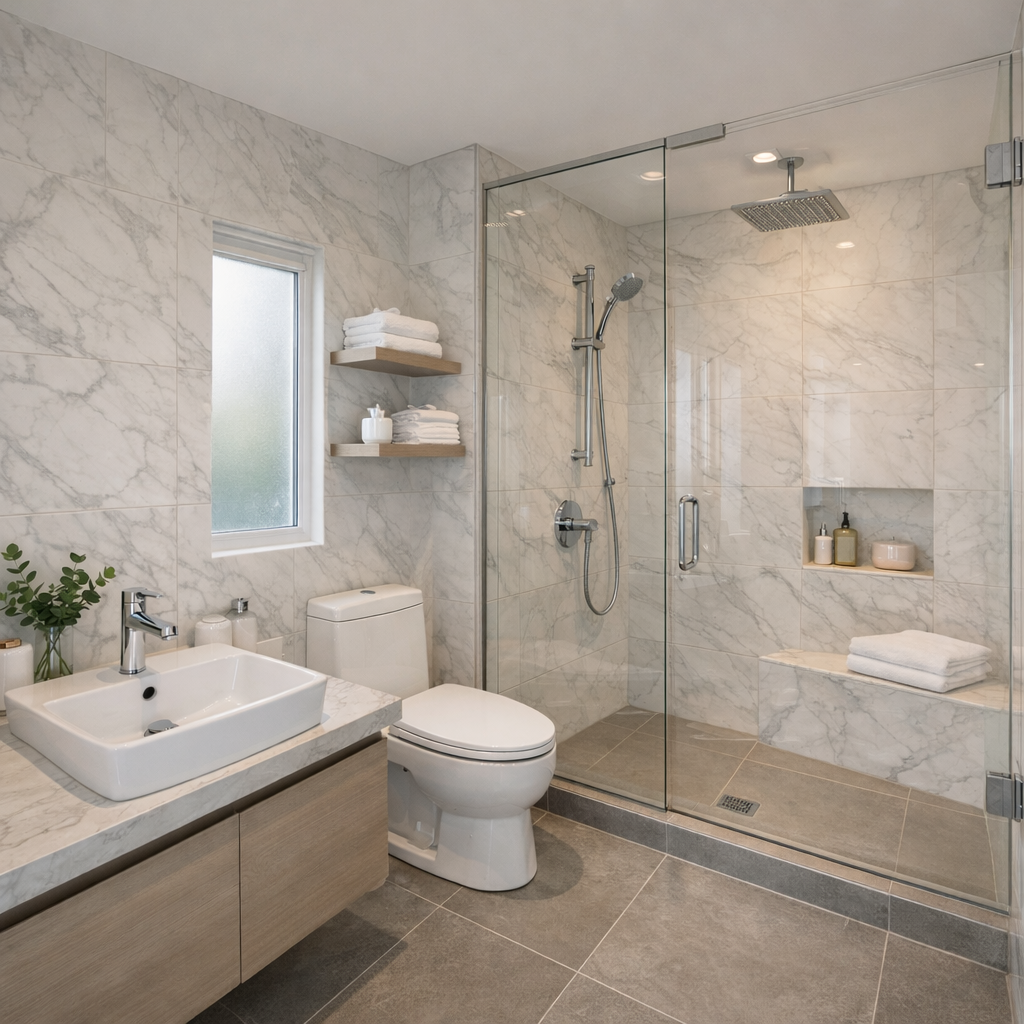
Commercial Bathroom Fixture Specifications: A Comprehensive AEC Design & Compliance Guide
Bathrooms in commercial and institutional buildings are among the most technically demanding environments in modern construction. From plumbing system integration and accessibility compliance to water efficiency targets and long-term durability requirements, bathroom fixture specifications directly influence building performance, operational cost, and regulatory compliance.
Purpose of This Guide
This guide provides a structured, research-based overview of commercial bathroom fixture specifications, relevant codes and standards, performance considerations, and lifecycle planning for Architecture, Engineering, and Construction professionals.

Why Bathroom Fixture Specifications Matter in Commercial Projects
Unlike residential applications, commercial bathrooms must address high-frequency use, multi-user access, accessibility standards, plumbing code compliance, water conservation mandates, vandal resistance, maintenance accessibility, and public health considerations.
Operational and Compliance Risk
Improper or incomplete specification can lead to code violations and construction change orders.
It can increase water consumption and drive higher lifecycle costs.
User Experience and Performance
Premature fixture failure and maintenance downtime reduce reliability in high-traffic environments.
User dissatisfaction increases when flushing, access, or clearances do not perform as expected.


Core Codes and Standards Governing Commercial Bathroom Design
Commercial bathroom design is shaped by multiple overlapping regulatory frameworks. Specifiers must coordinate across jurisdictions and align early across disciplines.
Plumbing Codes
International Plumbing Code, Uniform Plumbing Code, and local municipal amendments regulate fixture counts, pipe sizing, venting, backflow prevention, and minimum flow rates.
Accessibility Standards
ADA and ICC A117.1 define mounting heights, clear floor space, reach ranges, grab bar placement, and turning radius requirements.
Water Efficiency Regulations
EPA WaterSense criteria, state-level conservation mandates, and LEED frameworks influence flow targets and water reduction strategies.
Public Health Standards
ASSE performance standards, Legionella risk mitigation, and sensor-activated systems in healthcare environments shape design choices and maintenance planning.
Commercial Bathroom Fixture Categories and Specification Considerations
Fixture performance depends on pairing the right product type with pressure conditions, maintenance realities, and the intended user environment.
Water Closets
Key factors include flush volume, gravity versus pressure-assisted systems, wall-hung versus floor-mounted configurations, carrier compatibility, trapway design, load-bearing capacity, and maintenance access.
High-traffic facilities may require pressure-assisted systems to reduce double flushing and improve bowl clearing performance.
Urinals
Specification criteria include flush volume, drain line configuration, cartridge maintenance requirements for waterless systems, odor control strategy, and vandal-resistant design.
Waterless systems require lifecycle maintenance planning to prevent performance decline.
Lavatories
Lavatory selection affects plumbing and accessibility. Consider knee clearance, overflow configuration, integral versus separate basin design, material durability, faucet compatibility, and splash containment in healthcare settings.
Wall-mounted sinks require careful blocking coordination during framing.
Faucets and Touchless Systems
Touchless systems often require defined sensor activation range, power source, flow rate, temperature control, mixing valve coordination, vandal resistance, and maintenance accessibility.
Battery replacement schedules must be integrated into facility management planning.
Flush Valves and Controls
Options include manual handle, sensor-operated, dual-flush mechanisms, and concealed in-wall systems.
Compatibility with pressure ranges is critical to avoid misfire or incomplete flush cycles.
Coordination Priority
Correct pairing of fixture body, valve type, and pressure conditions reduces callbacks and ensures consistent performance in the field.
Water Efficiency and Sustainable Bathroom Design
Water conservation is no longer optional in commercial construction. Many jurisdictions mandate reduced flow rates, and project teams must balance efficiency with hygiene and performance.
Typical Commercial Flow Benchmarks
Toilets are commonly specified at 1.28 GPF or lower, urinals at 0.5 GPF or lower, and public lavatory faucets at 0.5 GPM.
Specification Strategies
Pressure-compensating valves, flow restrictors, greywater integration, rainwater harvesting where permitted, and smart metering can reduce total demand.
Water reduction strategies should be evaluated against performance and hygiene requirements.
Accessibility Compliance in Bathroom Design
Accessibility errors are among the most common inspection failures in commercial projects. Critical dimensions and control placements should be verified early in CAD and BIM workflows.
Critical Dimensions
Turning radius commonly targets sixty inches, toilet seat height typically ranges seventeen to nineteen inches, grab bars are often set thirty-three to thirty-six inches, and lavatory rim height is commonly limited to thirty-four inches maximum.
Common Specification Mistakes
Frequent issues include incorrect flush control placement, inadequate toe clearance, improper mirror mounting height, and door swing conflicts.
Early CAD and BIM verification reduces risk of non-compliance.
Lifecycle Performance and Total Cost of Ownership
Initial fixture cost is only one component of value. Long-term performance affects operational budgets, and a higher-quality fixture can reduce total lifecycle expense over ten to twenty years.
Lifecycle Considerations
Replacement intervals, sensor battery lifespan, valve diaphragm wear, surface staining resistance, cartridge replacement cost, and maintenance labor requirements should be evaluated during specification.
Operations Coordination
Facility managers should be consulted during specification development to align product choices with maintenance capacity and access realities.
Smart Plumbing and Emerging Technologies
Modern commercial bathrooms increasingly incorporate IoT-enabled flush systems, usage analytics, leak detection, automated maintenance alerts, and water usage monitoring dashboards.
Operational Benefits
Smart systems can support preventive maintenance, sustainability reporting, Legionella mitigation programs, and occupancy-based cleaning schedules.
Integration Requirements
Integration requires coordination with electrical and IT teams during early design phases to avoid late-stage conflicts.
Healthcare, Hospitality, and Education: Sector-Specific Considerations
Each sector requires a tailored specification strategy based on risk profile, usage patterns, and operational priorities.
Healthcare Facilities
Infection control is a priority. Hands-free operation, seamless surfaces, antimicrobial materials, and splash containment often drive selection.
Hospitality
Aesthetic integration, guest experience, water noise reduction, and concealed plumbing systems commonly influence fixture and control decisions.
Educational Institutions
Vandal resistance, high durability, simplified maintenance, and cost control typically shape the fixture package.
Specification Fit
Sector requirements should be translated into measurable criteria before procurement to reduce substitutions and field changes.
The Specification Process in AEC Workflows
A structured bathroom fixture specification process typically includes code analysis, occupancy classification review, fixture count calculations, performance criteria definition, water efficiency alignment, accessibility validation, BIM coordination, submittal review, and field verification.
Common Commercial Bathroom Specification Mistakes
Common issues include overlooking pressure requirements, pairing incompatible flush valves and bowls, ignoring maintenance access, failing to verify ADA clearances in construction drawings, selecting low-flow fixtures without performance testing, and omitting shutoff valve accessibility.
Future Trends in Commercial Bathroom Design
The next phase of bathroom specification is likely to include increased data integration, predictive maintenance systems, stricter water conservation codes, expanded touchless infrastructure, antimicrobial surface technologies, and modular prefabricated restroom assemblies.

Conclusion
Commercial bathroom fixture specifications sit at the intersection of plumbing engineering, regulatory compliance, sustainability planning, and architectural intent. Bathrooms are compact but technically complex environments that demand careful coordination.
A structured, research-based specification approach improves compliance reliability, water efficiency performance, lifecycle cost management, user safety and accessibility, and operational durability.