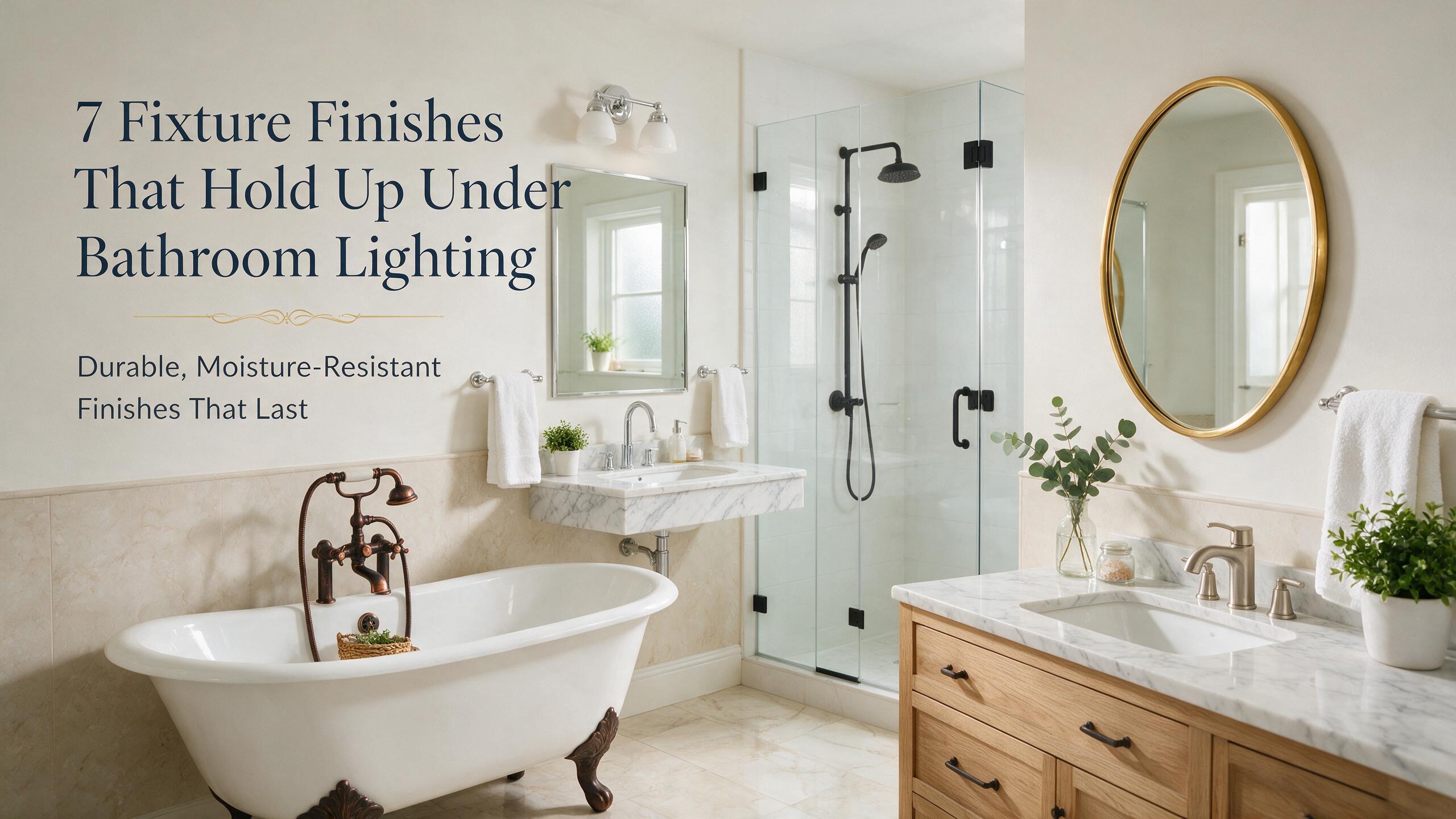

Chrome and brass read dull or greenish under the wrong light because most bathroom fixtures are fitted with cheap LEDs at 4000K or higher and CRI ratings in the 70s. Fix the light source first, then the placement. Get both right and polished chrome throws a clean white highlight, brushed brass holds its warmth, and neither finish shifts color depending on where you stand.
The selection rule: glare versus glow
Every placement in this list is judged on one thing: does it reveal the true color and texture of the metal, or does it bounce back as a hot white blob. Polished surfaces are mirrors at the scale of a light source. A bulb sitting directly in a fixture’s reflection zone will glare. A bulb positioned to graze the surface at an angle will glow. That is the whole test, and it is why placement matters more than lumen count.
Two numbers do the rest of the work. CRI 90+ ensures the light source renders metal hues and skin tones accurately, so brass looks like brass and not like old gold under fluorescent office lighting. Color temperature of 2700K to 3000K keeps warm-toned finishes such as brass, bronze, and gold looking rich rather than washed out or greenish, which is what happens under cooler 4000K+ light. Chrome and nickel tolerate a slightly cooler temperature, but staying in the 2700K to 3000K band keeps the whole room consistent if you’re mixing metals.
Vertical sconces at faucet height
Mount sconces at 60 to 66 inches above finished floor, flanking the mirror at roughly shoulder width apart. This height puts the light source level with or just above faucet height, so the beam hits the spout and handles at a low grazing angle instead of firing straight down onto a flat lens of glare. It’s the single best placement for showing off a faucet’s actual finish, whether that’s polished chrome or a warmer brass.
Frosted or opal diffusers matter here more than fixture style. A bare filament bulb at this height and this close to a mirror will bounce a second glare point off the glass. Choose sconces with a diffusing shade and confirm the CRI on the bulb, not just the fixture spec sheet, since many sconces ship with generic 80-CRI lamps that undercut an otherwise good design choice.
Placement checklist for sconces
- 60 to 66 inches AFF to centerline, level with the eyeline of someone standing at the sink
- 2700K to 3000K, CRI 90 or higher, listed on the lamp packaging or spec sheet
- Frosted, opal, or fabric shade to diffuse the point source
- Spaced to the width of the mirror or slightly narrower, never crowding a single fixture directly above the faucet
Overhead downlights and shadow risk
A single ceiling downlight centered over the vanity is the most common placement and the worst for metal finishes. Light coming straight down hits the top of a faucet or towel bar and throws a hard shadow underneath, which flattens the piece and can make brass look brown instead of gold. It also lights the top of your own head and casts shadows under your eyes, which is a separate problem but tells you the angle is wrong for the room generally.
If a downlight is unavoidable, either because of a low ceiling or an existing junction box, offset it 12 to 18 inches in front of the vanity rather than directly above it, and pair it with sconces or a mirror light so the shadow gets filled rather than left as the only light source. Downlights are fine for general room illumination. They are a poor primary source for showing off metal.
Mirror-integrated LED strips
LED strips built into or behind a mirror give even, shadow-free light across the face and, by extension, across anything reflective nearby. Because the light source is large and diffused rather than a small hot point, it doesn’t create the same glare risk as a bare bulb. This makes backlit or edge-lit mirrors a good secondary source for a room with brass or nickel hardware, since the wraparound glow fills in shadows that sconces alone might miss.
Check the CRI spec on the strip itself, not just the mirror’s marketing copy. Many budget backlit mirrors use inexpensive strip LEDs in the 80 CRI range, which is fine for shaving but noticeably flattens warm metal tones compared to a 90+ CRI source next to it.
Vanity lighting for mixed metal fittings
If a bathroom mixes finishes, chrome shower valve, brass faucet, matte black hardware, the temptation is to light for one and let the others fall where they may. Better approach: pick a single 2700K to 3000K, 90+ CRI light source for the whole room and let consistent color temperature do the work of unifying different metals. Mixed color temperatures in one room are what make one finish look correct and another look off, even when both are objectively good quality fixtures.
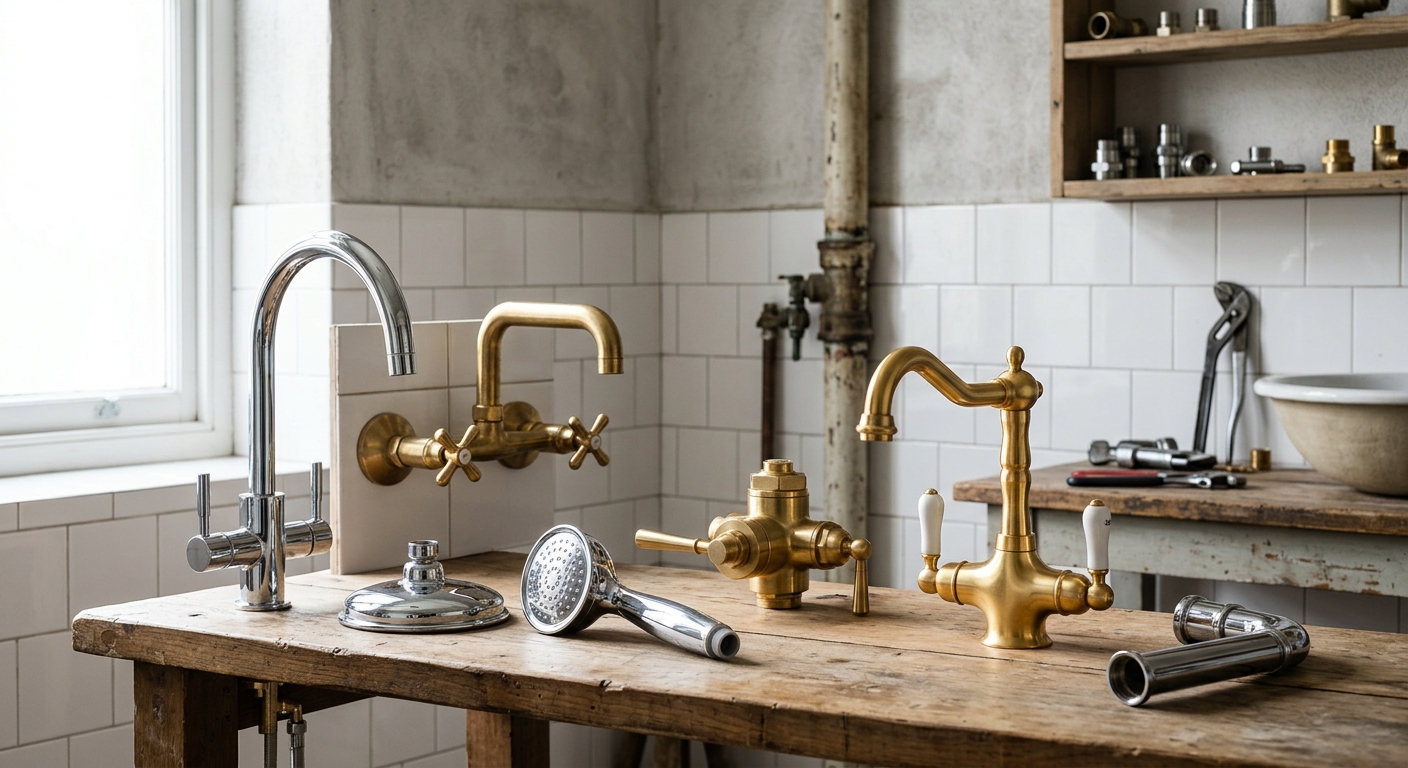
Traditional and period-style finishes benefit most from this consistency, since a lot of the visual identity of something like antique brass faucets depends on warm, low-glare light picking out the patina and tooling detail rather than cool light flattening it into a uniform tan.
| Placement | Best for | Watch for |
|---|---|---|
| Vertical sconces, 60-66 in AFF | Faucets, handles, mirror-adjacent hardware | Bare bulbs without diffusion |
| Offset downlight | General room fill | Direct overhead shadow on fixtures |
| Mirror-integrated LED strip | Even fill light, secondary source | Low CRI strips inside budget mirrors |
| Wet-zone rated fixture near tub | Tub fillers, freestanding faucets | Fixtures rated below IP44 in Zone 2 |
Wet-zone rated fixtures near tubs
Any light within Zone 2, the area within 60 cm of a bath or shower and up to 225 cm above the floor per BS 7671, needs a minimum IP44 rating. This isn’t a style choice, it’s electrical code, and it applies whether the fixture is lighting a chrome tub filler or a brass freestanding faucet. IP44 protects against splashes and small solid debris, which is the realistic exposure for a fixture mounted near a tub rather than inside a shower enclosure itself.
Because IP44 fixtures often ship with sealed or frosted lenses for weatherproofing, check the CRI and Kelvin spec before buying rather than assuming a wet-rated fixture automatically matches the warm, high-CRI light you used elsewhere in the room. Manufacturers sometimes pair wet ratings with whatever LED module was cheapest to seal, and that module is not always 90+ CRI.
What to check before you buy
Pull the spec sheet on every fixture you’re considering and confirm three numbers before anything else: CRI (90 or higher), color temperature (2700K to 3000K for warm metals, up to 3000K is still fine for chrome), and IP rating for anything inside Zone 2 (IP44 minimum). Confirm sconce mounting height against your actual mirror and vanity dimensions rather than a standard, since faucet height varies by model.
If you’re rewiring or adding circuits for new fixture locations, that’s an electrician’s job, particularly for anything inside Zone 1 or Zone 2 near a tub or shower. A lighting placement plan is something you can sketch yourself; the wet-zone wiring should go through someone licensed to sign off on it.