

The real difference between minimalist and traditional faucets is not the silhouette, it’s the hardware underneath it. Cartridge type, flow rate, and rough-in spacing change what the fixture does at the deck and in the wall, independent of finish. Pair the two profiles at matching rough-in dimensions and the specs tell you which one actually performs better for your install.
The Selection Rule: Matched Rough-In Pairs
To compare fairly, each pair below shares the same rough-in centers: either a 4-inch centerset or an 8-inch widespread. That means the minimalist and traditional versions bolt into the same holes, so any difference in performance comes from the cartridge, spout geometry, or escutcheon design, not from a mismatched install. If you’re retrofitting an existing vanity, measure your centers first; this is what tells you which pair you’re actually choosing between.
7 Matched Pairs at a Glance
| Pair | Rough-In | Minimalist Flow (GPM) | Traditional Flow (GPM) | Cartridge (Min / Trad) |
|---|---|---|---|---|
| 1 | 4-inch centerset | 1.5 | 2.2 | Ceramic disc / Compression |
| 2 | 8-inch widespread | 1.5 | 2.2 | Ceramic disc / Compression |
| 3 | 4-inch centerset | 1.2 | 2.2 | Ceramic disc / Ceramic disc |
| 4 | 8-inch widespread | 1.5 | 1.5 | Ceramic disc / Ceramic disc |
| 5 | 4-inch centerset | 1.2 | 2.2 | Ceramic disc / Compression |
| 6 | 8-inch widespread | 1.5 | 2.2 | Ceramic disc / Compression |
| 7 | 4-inch centerset | 1.5 | 1.8 (CA compliant) | Ceramic disc / Ceramic disc |
Spout Reach and Deck Clearance Compared
Minimalist spouts tend to run 4.5 to 5 inches from the base to the center of the stream, low profile, often under 3 inches tall at the arc. Traditional spouts, particularly gooseneck and bridge styles, reach 6 to 8 inches and clear the deck by 7 to 9 inches, which matters if you’re filling a deep vessel sink or a basin with a high rim. The tradeoff is splash: more reach and height means more spread in a shallow basin, so match spout height to basin depth before you match it to style.
Deck clearance behind the spout also differs. Minimalist single-hole units need as little as 2 inches of clear deck behind the faucet base. Widespread traditional sets need enough clearance for separate hot and cold valves plus the spout, typically a full 8 to 10 inch footprint across the back of the counter. On a shallow vanity under 20 inches deep, this clearance constraint rules out traditional widespread before flow rate or finish ever enters the conversation.
Cartridge Type and Handle Turn Radius
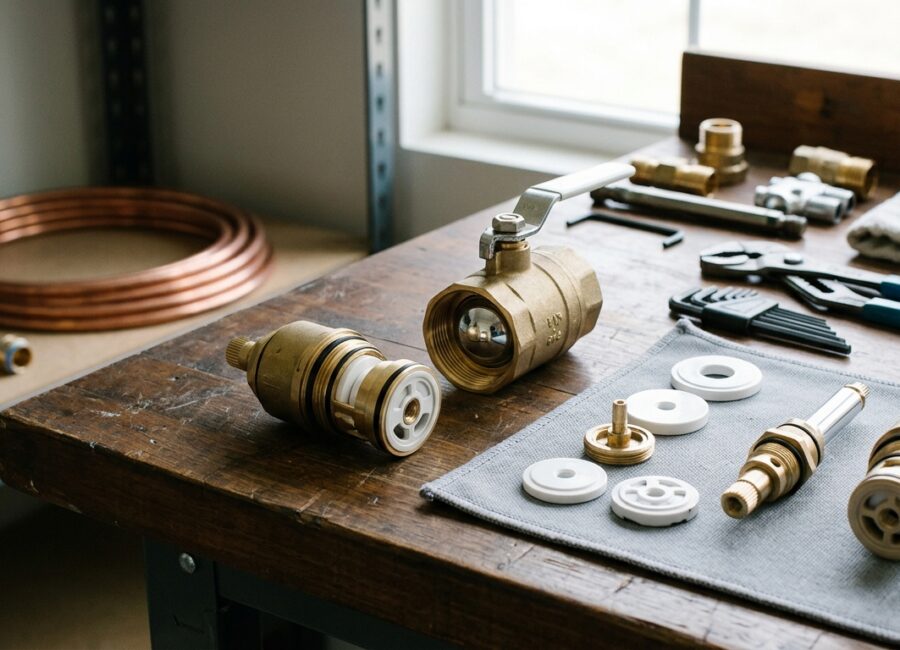
Most minimalist single-handle faucets use a ceramic disc cartridge: two polished discs that rotate against each other to control flow and temperature in one motion. These need roughly a quarter turn, about 90 degrees, to go from off to full flow, and they rarely drip because the discs seal under direct contact rather than compression. Traditional two-handle sets more often use compression stem valves with a rubber washer, which need two full rotations, 360 degrees, per handle to fully open. That’s not a style choice, it’s a mechanical one: compression valves are simpler to rebuild in the field with a washer kit, while ceramic disc cartridges are typically replaced as a sealed unit.
Some traditional sets, including period-style bridge faucets, now ship with ceramic disc cartridges inside a compression-style handle body, so don’t assume the handle shape tells you the cartridge type. Ask or check the spec sheet before you buy, especially if you’re sourcing period style faucets in an antique brass or living finish, since manufacturers frequently update internals while keeping the exterior unchanged.
Flow Rate Differences Across Profiles
Federal maximum for bathroom faucets is 2.2 gpm at 60 psi; California’s Title 20 caps it at 1.2 gpm for lavatory faucets specifically (not to be confused with the 1.8 gpm shower head cap in that state). In the pairs above, minimalist faucets cluster at 1.2 to 1.5 gpm because low-flow aerators are standard on most ceramic disc single-handle models sold today. Traditional two-handle sets, especially those built on compression valves, are more often specified at the 2.2 gpm federal max, since older-style compression architecture wasn’t originally designed around flow restriction and many manufacturers haven’t retrofitted it.
This means the minimalist profile usually wins on water use by default, not because the shape is more efficient, but because that’s where aerator manufacturers have focused restrictor hardware. If you want a traditional look with lower flow, you can usually special-order a 1.5 gpm aerator insert for a compression-valve spout without changing the handle style at all.
Escutcheon Diameter and Wall Prep
Minimalist faucets typically use a slim escutcheon, 1.5 to 2 inches in diameter, which covers minor rough-in misalignment but won’t hide an old 3-hole 8-inch spread if you’re converting to single-hole. Traditional widespread escutcheons run larger, 2.5 to 3.5 inches, and are sometimes stepped or domed, which gives more forgiveness for rough-in centers that are off by a half inch in either direction.
If you’re remodeling and keeping the existing holes, check escutcheon diameter against your actual counter cutout before ordering:
- Single-hole minimalist: escutcheon 1.5 to 2 inches, cutout typically 1.25 inches
- 4-inch centerset: escutcheon or baseplate spans the full 4 inches, covering minor gaps
- 8-inch widespread traditional: individual escutcheons 2.5 to 3.5 inches per handle, spout separate
- Wall-mount traditional: escutcheons are typically deeper, 3 to 4 inches, to cover valve stem and supply lines inside the wall
When Traditional Profiles Outperform Minimalist
Traditional compression-valve faucets win on field serviceability. A worn washer is a five-minute fix with parts available at any hardware store, while a failed ceramic disc cartridge usually means ordering the exact replacement cartridge from the manufacturer, which can mean weeks of downtime on a single bathroom. For rental properties or any installation where a plumber needs to fix things fast without special-ordering parts, compression valves remain the more practical choice despite the higher flow rate and two-handle operation.
Traditional spout reach and deck clearance also outperform minimalist in rooms with deep vessel basins or furniture-style vanities, where a short minimalist spout simply can’t clear the rim. In those cases the traditional profile isn’t a style preference, it’s the only one that physically works with the basin you’ve chosen.
What To Check Before You Order
Pull the rough-in centers first, either 4-inch or 8-inch, since that decides which pairs are even eligible. Then check your basin depth and rim height against spout reach, confirm cartridge type on the actual spec sheet rather than assuming it from the handle style, and verify escutcheon diameter against your existing cutout if you’re not re-drilling the counter. If flow rate matters for your jurisdiction, confirm the aerator spec directly, since the same faucet body is sometimes sold with different flow restrictors depending on region. For anything involving moving rough-in centers or converting a widespread to a single-hole, that’s a plumber’s job, not a weekend swap.