
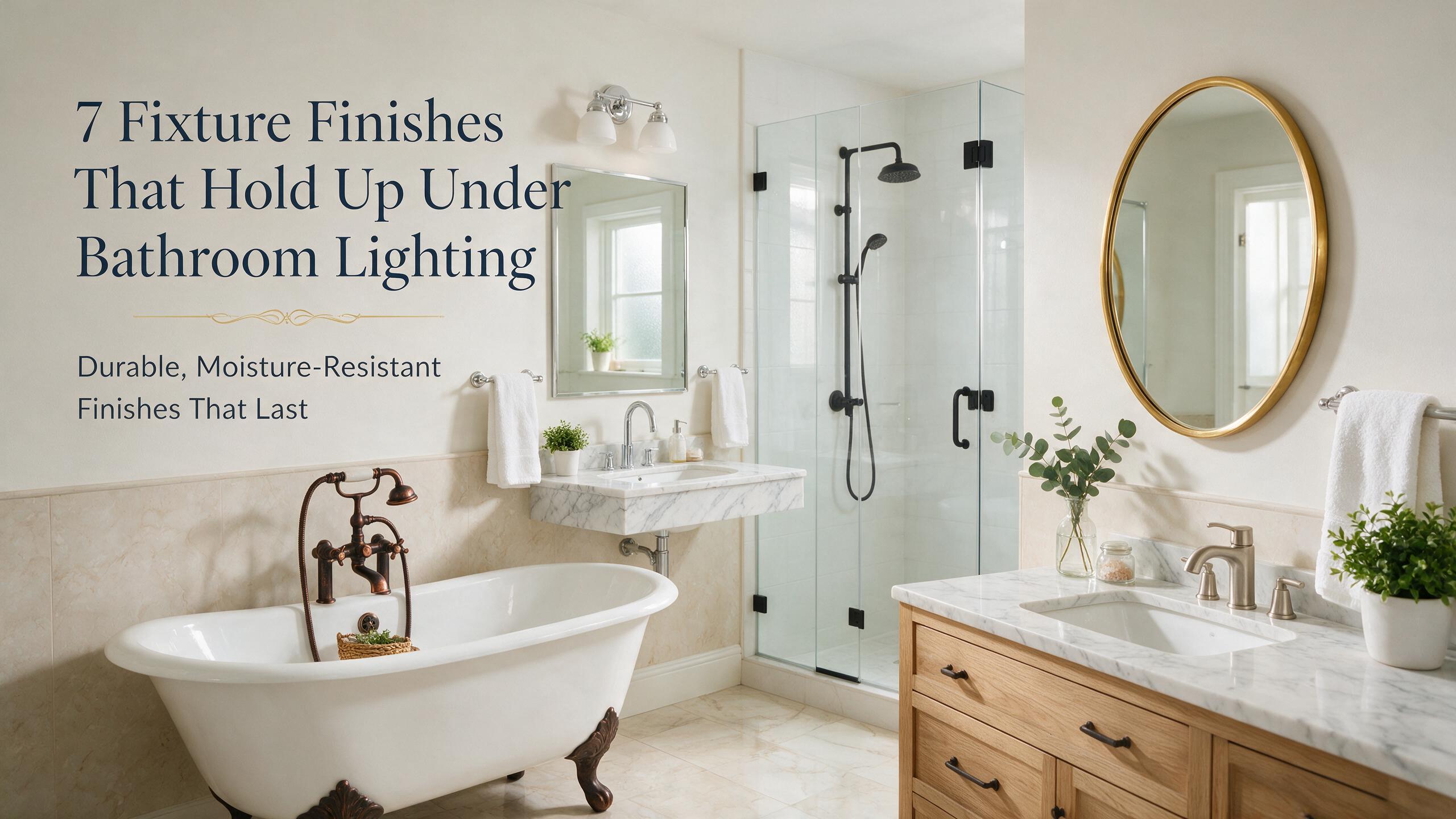
The finish that matches your tile in the showroom can look wrong at home because the light temperature is different. Showrooms typically run 3000K to 4000K at high CRI, but most bathrooms are lit with a mix of 2700K vanity bulbs and whatever daylight comes through the window. Pick your fixture finish by checking it against your actual bulb temperature first, then use tile undertone as the tiebreaker.
The Selection Rule: Light Temperature First
Every metal finish shifts color depending on the Kelvin temperature of the light hitting it. Brushed brass under 2700K reads warm and buttery. The same brass under 4000K reads flatter, almost bronze. Chrome is the most stable across temperatures because it has no inherent color cast, but it can look sterile under warm light and clinical under cool light.
Before you choose a finish, find out what bulbs are actually going into the room. Recessed cans, vanity strips, and any skylight or window light all count. If you’re mixing 2700K downlights with 4000K vanity bars, plan the finish choice around the light source closest to the fixture, since that’s what you’ll see most often when using the sink or shower.
- 2700K – warm white, close to incandescent. Flatters brass, gold, and warm bronze. Can make chrome look slightly cool or blue by contrast.
- 3000K – soft white, the most common residential choice. Balanced enough to work with most finishes without exaggerating warm or cool casts.
- 4000K – cool white, closer to daylight. Favors chrome, nickel, and cool-toned black finishes. Tends to mute the warmth in brass and gold.
Shortlist for Warm Tile Undertones
Warm tile, meaning cream, beige, terracotta, or anything with a yellow or pink base, needs a finish that won’t fight the undertone under whichever bulb is installed.
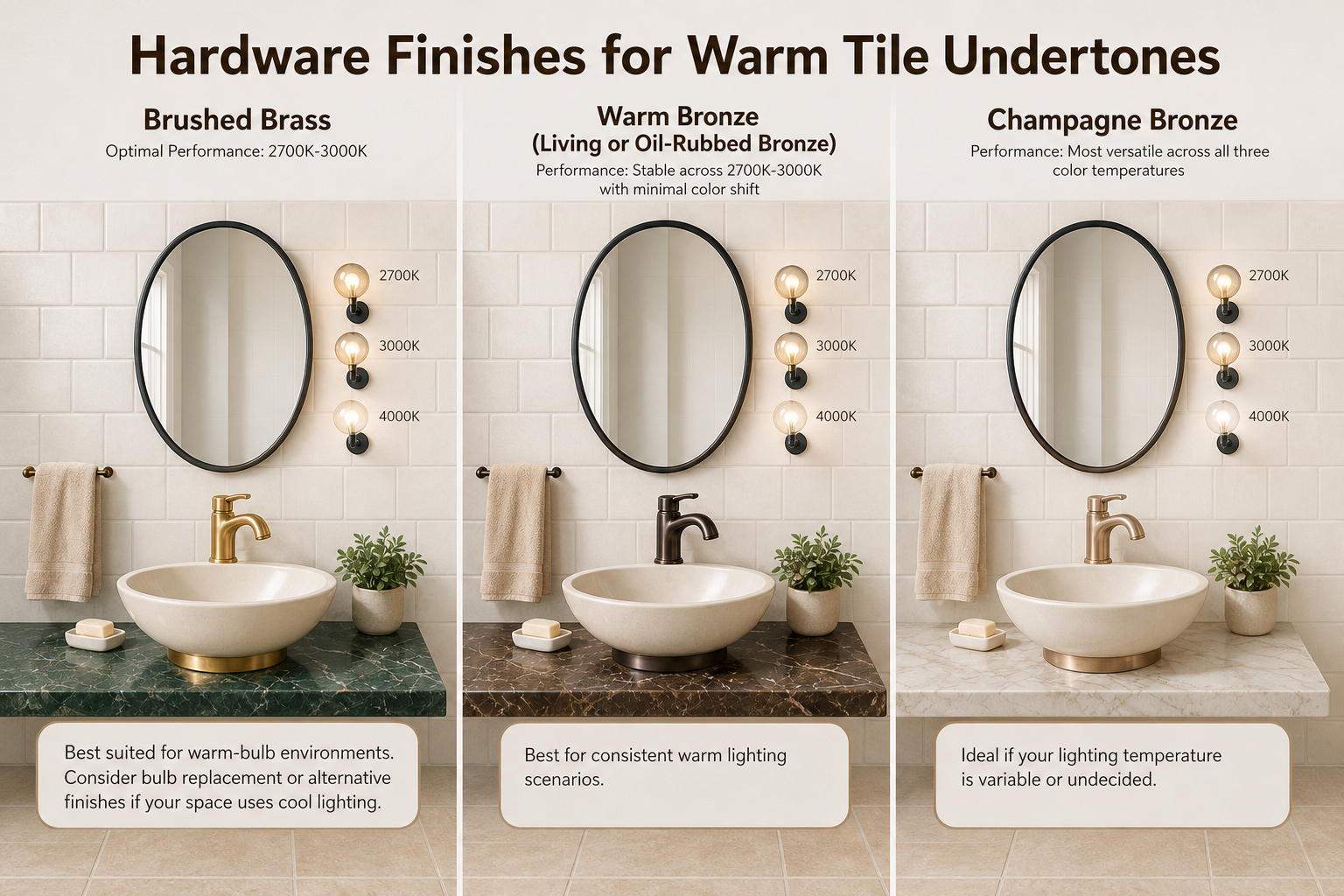
- Brushed brass – Best under 2700K to 3000K. At 4000K it loses some of its glow and can look slightly greenish next to warm tile. If your room runs cool bulbs, skip this finish or plan to swap bulbs.
- Warm bronze (living or oil-rubbed) – Holds up across 2700K to 3000K with minimal shift. At 4000K the brown tones flatten and the finish can start to read closer to a dark pewter.
- Champagne bronze – A safer middle ground than brass. It has enough gray in the mix that it doesn’t overheat under warm light and doesn’t go cold under 4000K. Works across all three temperatures better than pure brass or gold.
Shortlist for Cool Tile Undertones
Cool tile, meaning gray, blue-gray, white with a blue base, or greige with more gray than tan, pairs better with finishes that don’t introduce a warm cast the tile wasn’t designed for.
- Polished chrome – Neutral at every temperature tested here, which is why it remains the default in commercial specs. Under 2700K it can look a touch flat; under 4000K it looks crisp and matches cool tile without a fight.
- Brushed nickel – Slightly warmer than chrome but still reads neutral-to-cool. Performs well at 3000K and 4000K. Under 2700K it can pick up a faint yellow cast, which matters if your tile is a cool gray with blue undertones.
- Matte black – Technically not a color-temperature-sensitive finish since it absorbs rather than reflects, but under low CRI bulbs at any temperature it can look slightly brown or green instead of true black. Pair only with 90+ CRI sources.
How Low CRI Distorts Metal Color
CRI, or Color Rendering Index, measures how accurately a light source reveals true color compared to natural daylight, on a scale to 100. Most residential LED bulbs sold at hardware stores fall between 80 and 85 CRI, which is enough for general use but not enough for judging metal finish accurately. Specify 90+ CRI minimum for any vanity or shower light if the finish color matters to you.
Under 80 CRI light, brass can look slightly orange or muddy instead of warm and clear. Chrome can pick up a faint green or purple tint depending on the phosphor coating in the bulb. Black finishes lose depth and start to look charcoal instead of true black. This isn’t a flaw in the fixture. It’s a flaw in the bulb’s spectral output, and no amount of finish selection fixes it if the CRI is low.
If you already installed fixtures and the finish looks wrong, check the CRI rating on the bulb packaging before assuming you chose the wrong metal. Swapping a 80 CRI bulb for a 90+ CRI bulb of the same Kelvin temperature often solves the problem without touching the fixture.
Matching Sheen Level to Tile LRV
LRV, or Light Reflectance Value, measures how much light a surface bounces back, on a scale from 0 (absolute black) to 100 (pure white). Tile with a high LRV, typically 70 and above, reflects more ambient light onto nearby fixtures, which makes polished finishes look brighter and busier than they would against darker tile.
If your tile has an LRV above 70, consider a brushed or satin finish rather than polished. The reflected light from high-LRV tile combined with a mirror-polished faucet can create glare and hot spots, especially under 4000K lighting. Against low-LRV tile (30 and under, deep charcoal or navy for example), a polished chrome or nickel finish reads as a clean highlight rather than a glare point, because there’s less ambient reflected light competing with it.
Matte and brushed finishes are more forgiving across a wider LRV range because they scatter light instead of bouncing it directly. If you’re unsure of your tile’s LRV, ask your supplier. Most manufacturers list it on the spec sheet, and it’s worth checking before committing to a high-polish finish in a small bathroom with bright tile and multiple light sources.
Quick Reference by Room Type
| Room Type | Typical Light Temp | Best Finish Match | CRI Minimum |
|---|---|---|---|
| Primary bath, warm tile | 2700K-3000K | Champagne bronze or brushed brass | 90 |
| Primary bath, cool tile | 3000K-4000K | Brushed nickel or polished chrome | 90 |
| Powder room, high-LRV tile | 2700K-3000K | Satin brass or matte black | 90 |
| Guest bath, mixed lighting | 3000K blend | Champagne bronze (most forgiving) | 90 |
| Kids’ bath, cool tile | 4000K | Polished chrome | 85 (durability priority) |
For any finish on this list, ask about PVD (physical vapor deposition) coating if the fixture will see daily use. PVD finishes resist scratching and tarnish far better than plated or painted finishes, which matters most on faucet handles and shower valve trims that get touched multiple times a day. It doesn’t change the color under different light temperatures, but it keeps the finish looking the way it did on day one instead of wearing to a duller tone within a few years.
Before ordering fixtures, bring a tile sample and a metal finish sample into the actual bathroom at night with the real bulbs on. Compare it again in daylight if the room has a window. If the finish still reads true under both conditions, you’ve done the one test that showroom lighting can’t replicate. If it shifts noticeably, check the bulb’s Kelvin and CRI rating before assuming the finish was the wrong choice.