
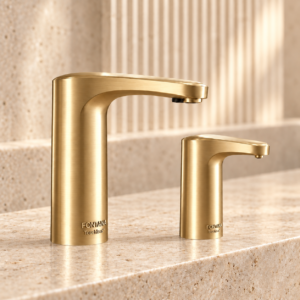


Yes, you can mix faucet brands in a bathroom, but the decision should be made at the plumbing-spec level, not the finish-swatch level. Six checks determine whether a lavatory faucet from one manufacturer will physically work with a shower valve or tub filler from another, and whether their finishes will read as intentional rather than mismatched once the lights are on.
The Selection Rule for This List
Every fixture on a pass/fail list here has to clear a hard compatibility test, not a style preference. That means checking supply thread standards, rough-in spacing, cartridge architecture, and finish process before anyone opens a swatch book. If a pairing fails on threads or rough-in, no amount of styling coordination fixes it. If it fails on finish tolerance, it is a visual risk you can decide to accept. Those are two different categories of problem, and this list treats them separately.
Thread and Rough-In Compatibility
Supply connections are the easiest check and the one most people skip because they assume universality. In the US, faucet supply connections are built to ASME A112.18.1, which standardizes the 1/2 inch NPT (or the compatible compression fitting) connection point between the faucet and the supply line. Any faucet sold for US residential use that meets this standard will thread onto a standard supply stop, regardless of brand. This is the one place where brand mixing is almost never the problem.
Rough-in spacing is where mixing actually breaks down, and it has nothing to do with thread standards. Widespread faucets are sold in two common spreads, 4 inch (sometimes called mini-widespread) and 8 inch center-to-center, measured from the centerline of the hot valve to the centerline of the cold valve. A centerset faucet, by contrast, has the valves and spout fixed on a single base, typically on 4 inch centers, and is not adjustable. If your sink or vanity top was drilled for an 8 inch widespread and you buy a centerset from a different brand expecting it to fit, it will not. Before ordering anything, measure your existing rough-in or check the cutout spec on the vanity top, and confirm the new faucet’s spread against that measurement, not against the old faucet’s brand name.
- 4 inch centerset: fixed base, handles and spout on one unit, works with 4 inch predrilled sinks.
- 4 inch mini-widespread: separate handles and spout, flexible supply lines, fits same 4 inch holes as centerset.
- 8 inch widespread: separate handles and spout with greater spread, requires 8 inch (or 6 to 16 inch adjustable) predrilled sink or deck.
Tub and shower rough-in follows the same logic but is less visible until demo. Valve body depth, shower arm length, and diverter spacing vary by brand and by product line within a brand, so a replacement valve from a different manufacturer may need the supply lines re-run even if the wall opening looks similar.
Finish Consistency Under Bathroom Lighting
Finish mismatch is a real risk when mixing brands, and it is driven by the plating process, not the color name on the spec sheet. Two main processes produce today’s finishes: PVD (physical vapor deposition) and traditional electroplating. PVD finishes are generally more color-stable over time and more resistant to acidic cleaners, which means a PVD brushed gold faucet bought today will likely still match a PVD brushed gold shower trim bought two years from now. Electroplated finishes can drift in tone across production runs and tend to patina or oxidize faster, especially in finishes like unlacquered brass.
The problem compounds when you mix an electroplated fixture from Brand A with a PVD fixture from Brand B, even if both are labeled “brushed nickel.” Brand naming for finishes is not standardized, so “brushed nickel” at one manufacturer may run warmer or cooler than at another, and the two processes reflect light differently under LED vanity lighting, which is where most bathroom finish mismatches get noticed. If you are mixing brands, order samples or small hardware pieces first and view them side by side under the actual bulb temperature going into the room, not under showroom lighting.
| Finish Process | Color Stability | Cross-Brand Risk |
|---|---|---|
| PVD | High, resists tarnish and fading | Lower, but brand-to-brand hue still varies |
| Electroplated | Moderate, can shift with wear and cleaning chemicals | Higher, especially in brushed and matte finishes |
Valve and Cartridge Interchangeability
This is the check with the highest cost of getting wrong, because it is buried in the wall. Most modern shower valves use ceramic disc cartridges, which are durable and low-maintenance, but the cartridge geometry (stem length, spline pattern, body diameter) is proprietary to each manufacturer and frequently proprietary to a specific product line within that manufacturer. A ceramic disc cartridge from one brand will not drop into another brand’s valve body, even though both are technically “ceramic disc” construction.
This matters most at renovation or repair time. If you install a shower valve from Brand A behind tile and later want to switch the trim to Brand B for styling reasons, you usually cannot just swap the decorative trim and keep the valve, because the trim kit and the valve body are matched as a set. Some manufacturers do sell trim-only kits designed to fit specific competitor valve bodies, but this is the exception, not the rule, and it requires confirming the exact valve model before ordering. When you are shopping shower faucet sets, check whether the trim and valve are sold together or separately, because that tells you whether future trim changes will require tearing into the wall again.
The practical takeaway: decide your shower valve brand and trim early and treat it as a long-term commitment, since it is the one part of the system that is expensive to change later.
When Mixing Brands Actually Saves Money
Mixing brands makes the most sense in two situations, both of which have a technical basis rather than just a budget basis. First, lavatory faucets and tub fillers are exposed fixtures with standardized rough-in and thread connections, so they are low-risk to source from a different brand than your shower valve. You are not fighting proprietary cartridge geometry here, only rough-in spread and finish match. Second, if you are replacing an exposed faucet but keeping an existing, still-functional shower valve body, buying a compatible trim kit (confirmed against the valve model) from the same brand as the valve, while sourcing the lavatory faucet elsewhere, avoids re-plumbing while still giving you flexibility on the visible fixture.
Where mixing brands does not save money is at the rough-in stage of new construction or a full gut renovation. At that point, the labor cost of setting valve bodies is the same regardless of brand, so the savings from a cheaper valve rarely offset the risk of finish mismatch or future trim incompatibility.
Final Suite vs Mix Checklist
- Confirm supply thread standard (ASME A112.18.1) on any lavatory faucet or tub filler before ordering; nearly all US-market faucets will pass.
- Measure existing rough-in spread (4 inch centerset, 4 inch widespread, or 8 inch widespread) against the new faucet’s spec sheet, not against the old fixture’s brand.
- Request physical finish samples from both brands and compare them under the room’s actual bulb temperature, not showroom lighting.
- Identify the finish process (PVD or electroplated) for each fixture; mixing two PVD finishes is lower risk than mixing PVD with electroplated.
- Before ordering a shower valve, confirm whether trim and valve body are sold as a matched set or separately, and whether replacement trim is available if you change brands later.
- Treat shower valve and cartridge selection as the long-term, behind-the-wall decision; treat exposed faucets and fillers as the flexible, swappable decision.
If you are unsure whether a rough-in measurement or valve model matches what you are planning to install, bring the spec sheet to a plumbing supply counter or have a licensed plumber confirm it before you place the order. A five-minute check against a cut sheet is cheaper than a return shipment or an opened wall.